


Monthly Archives

March 2026

Corporate investments – keeping surplus funds productive

By | Financial Planning

For businesses that find themselves holding significant cash reserves, leaving funds idle in a business bank account, earning little or no interest, is rarely the most efficient strategy. Whether the surplus cash has arisen from profitable trading, the sale of an asset, or simply disciplined cash management, company directors should consider the benefits of keeping surplus funds productive, whilst balancing prospective returns, access to capital and risk.

Most companies will aim to keep a safe operating balance held on immediately available cash. The amount that a company should hold as cash varies depending on a range of factors, including fixed operating costs, anticipated expenditure, Corporation Tax and other liabilities, together with any expected variance in forthcoming trading conditions. We always recommend directors consult with their company’s accountant to help determine the most appropriate level to hold as immediate working capital.

Once immediate needs have been determined, it is important to look to keep additional funds productive, as not doing so presents a missed opportunity to generate additional returns on idle funds but also leaves company cash exposed to the eroding impact of inflation. It is sensible to identify the investment time horizon for any funds not held on immediate cash, to divide funds into a proportion that is easily accessible and separate funds that can be committed to longer-term investments.

Savings options

Business savings accounts provide a straightforward option. Easy access savings accounts tend to offer lower rates of interest, but provide quick access to funds, which may prove invaluable if the business needs to deploy funds at short notice. Beyond immediate access, banks and other financial institutions offer notice and fixed term deposit options, which offer higher rates of interest, but require cash to be locked away for a defined period. In the case of fixed term deposits, the bank will almost certainly not allow earlier access to funds during the fixed term, and therefore caution should be employed to make sure sufficient liquidity is maintained.

Corporate investments

Businesses are not restricted to holding surplus company funds as cash. Investing surplus company funds can generate improved returns to those available on deposit; however, care is needed to select the right mix of asset classes, considering when funds may conceivably be needed, and the level of risk that the directors feel comfortable with.

The first option to consider are money market funds, which are pooled investments that invest in fixed and floating rate notes, high-quality debt instruments and short-dated gilts and corporate bonds. Despite the composition of a money market fund, the fund is not risk free, although returns offered are generally higher than cash deposits.

Companies seeking to employ company cash more effectively could consider investment grade corporate and government bonds, with the aim of generating better returns than those offered by money market funds. When investing in fixed income securities, inflation risk can effectively be reduced by selecting bonds with short dates to redemption.

For company funds that can be invested for a longer period, a diversified portfolio of equities (shares) could provide greater returns, albeit with higher levels of investment risk. By constructing a portfolio across these asset classes, in combination with a sensible strategy for short term cash, businesses can look to build a portfolio designed to keep surplus funds productive, whilst meeting liquidity requirements.

The graph below demonstrates the performance of the CDI Defensive Growth portfolio, a discretionary managed portfolio taking low-medium levels of investment risk, compared to a deposit account that tracks the Bank of England base rate, over the last 3 years. The graph shows the total return achieved, i.e. with income reinvested, but does not take into account investment management or platform charges.
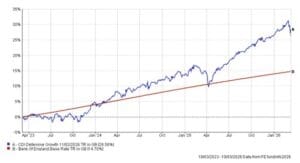
As demonstrated by the graph, by taking a relatively modest level of investment risk, an invested portfolio has historically outperformed returns on cash, although some investment volatility will have been tolerated.

HMRC investment company rules

In our experience, directors are often unaware of HMRC rules when investing surplus funds held by a business, which can have significant consequences if not followed, including the potential loss of Business Asset Disposal Relief, which delivers a reduced Capital Gains Tax rate when directors sell shares in a “trading company”.

HMRC broadly define a “trading company” as one where the majority of the activities undertaken relate to a trade, rather than the investment activity itself. As a rule of thumb, if

20% or more of the company’s income is derived from investments, or 20% of the directors’ time is spent dealing with investments, or 20% of the company’s assets are held in investments, this could jeopardise a company’s trading status in the eyes of HMRC. These are, however, only guidelines, and we regularly liaise closely with company accountants to review the financial position of the company and the implications of any investments held.

Streamlined solutions

When speaking with company directors, we often find investment of surplus funds to be something of an afterthought; however, with sensible planning and expert advice, businesses can aim to keep surplus funds productive.

Thanks to our independent status, we have access to a range of investment platforms that can provide an ideal solution for surplus company cash. Through careful due diligence, we have identified UK based platforms that offer readily accessible savings and fixed term deposits via a range of renowned deposit takers, but also provide the ability for a discretionary managed or advisory investment portfolio to be held on the same platform. This provides a streamlined solution, easing the administrative burden and providing clear visibility.

We are very used to helping businesses invest surplus cash effectively. We can construct bespoke investment portfolios aimed to match the time horizon and risk profile for the funds in question, or manage funds on a discretionary managed basis, thus ensuring the portfolio is regularly reviewed and rebalanced.

If you are a director of a company that holds surplus funds, speak to one of our independent advisers about the options available to deploy those funds more productively.


Capital Gains Tax – the hidden cost of inaction

By | Financial Planning

Minimising tax – or eliminating a potential tax liability altogether – is one of the key drivers behind most sensible financial planning decisions. Whether using efficient vehicles such as Individual Savings Accounts (ISAs) or pensions, or considering investments that provide tax relief, such as Venture Capital Trusts, achieving a tax-efficient outcome can maximise investment returns; however, there are limited situations where paying tax can be beneficial, and one of these is centred on decisions to crystallise gains where Capital Gains Tax (CGT) becomes payable.

Background to CGT changes

Over the past few years, tax legislation on gains made from the sale of an asset has been tightened on multiple fronts simultaneously. CGT is paid on the profit made on disposal of an asset that has increased in value. There are only limited exceptions where CGT does not apply, for example investments held in tax wrappers such as an ISA or pension, or the sale of your primary residence.

Since 2023, the annual CGT exemption (on which CGT is not paid) has been slashed from £12,300 all the way down to £3,000 in the current tax year. This means that many more investors are now dragged into paying CGT, and for those with larger portfolios, CGT is becoming much harder to avoid. Apart from the reduction in CGT exemption, rates of CGT payable have also increased, with basic rate taxpayers now paying 18% on gains above the exemption and higher and additional rate taxpayers now paying 24%. These rates are 8% and 4% higher respectively than the rates that applied before October 2024.

Practical steps to reduce a CGT liability

There are limited steps you can take to reduce or avoid a liability to CGT. Firstly, using tax-efficient wrappers, such as ISAs, Investment Bonds or Pensions, is a sensible step as gains made within these wrappers are exempt from CGT.

Despite the sizeable reduction in the CGT annual exemption, it is important to make use of the exemption where possible. As we approach the end of the tax year, now is a sensible time to review whether you should take action to make use of the exemption.

Married couples can maximise the use of their individual CGT exemptions by transferring assets to each other. Such transfers between spouses are exempt from CGT and provide the opportunity to take full advantage of both allowances.

A further consideration for those in later life is the uplift assets receive when valued for probate purposes. As the base cost that beneficiaries acquire assets from an estate is reset to the value at date of death, unrealised gains are effectively wiped out under current legislation.

Consider the opportunity cost

With the reduction in CGT exemption and higher rates of CGT payable, it can be tempting to fall into the trap of trying to actively avoid taking action, for fear of the CGT consequences. Giving back 18% or 24% of the profit made in tax, whilst unpalatable, however, may be preferable to the potential cost of not taking action.

Consider the position of Mary, a higher-rate taxpayer, who holds a single investment worth £100,000, which has doubled in value from the original £50,000 cost of purchase. The investment has traditionally performed well, but has struggled over recent years, and Mary therefore contemplates selling the investment. If she goes ahead, this crystallises a gain of £50,000, which is £47,000 above Mary’s annual exemption of £3,000. As a higher rate taxpayer, Mary would pay CGT at a rate of 24%, leading to a CGT liability of £11,280.

Mary goes ahead with the sale and reinvests the net sale proceeds of £88,720 (£100,000 sale proceeds less CGT payable) into another investment fund with better prospects for outperformance. After four years, Mary reviews her decision and notes that the new fund has made a compound return of 9% per annum since disposal, whereas the fund Mary held previously has only produced compound returns of 4.5% per annum over the same period. Mary’s investment value now exceeds what her investment would have been worth, taking into account the CGT payable, and she is holding a fund showing improved returns which could potentially mean her decision to switch investments becomes even more valuable in years to come.

Other hidden dangers

The above is a simple example that demonstrates the need to look beyond the potential tax hit and consider the opportunity cost of avoiding a CGT liability. There are, however, other risks that inertia can bring. One risk that could be exacerbated by avoiding a CGT liability is that an investment grows disproportionately in size compared to other assets held, leading to excessive concentration risk. This is particularly true for single investment holdings, where investors are faced with the growing risk that a downturn in the particular market could have an even greater impact. By regularly reviewing an existing portfolio and taking decisions on a discretionary managed or advisory basis, you can keep a cap on unrealised gains and avoid this situation occurring.

An impartial perspective

When faced with investment decisions that could create a CGT liability, inertia could prevent you taking actions that could damage your financial wealth over the longer term. Reframing the tax liability as a tax on gains already made, and focusing on the potential benefits of redeploying funds, can be beneficial. Independent financial advice can prove hugely valuable in this regard, as the input of a skilled and experienced adviser can provide you with an impartial perspective on the best course of action to take. Speak to one of the team to start a conversation.

Our initial reaction to war in Iran

By | Financial Planning

The key anxiety affecting market confidence is the impact a prolonged regional war could have on global energy supplies. Around 20% of global oil supply passes through the Straits of Hormuz, where tanker traffic has effectively ceased due to drone attacks, and understandably, insurers are not willing to cover traffic movements. The US has mooted the possibility of providing insurance and naval escort, which may help ease the logjam.

Despite this, oil prices are likely to remain elevated for the foreseeable future, and gas prices have also jumped higher after Qatar temporarily halted the production of liquified natural gas; however, to put the price increases in context, Brent and WTI crude prices still remain a considerable way below the highs seen just after the Russian invasion of Ukraine in 2022.

The partial blockage of the Straits of Hormuz is likely to weigh most heavily on countries that rely on energy supplies from the Gulf, such as Japan, South Korea, and India. In addition, freight that now needs to use the route around the Cape of Good Hope will be subject to delays in reaching its intended destination and additional costs.

Furthermore, broader conflict of this scale is likely to weigh on specific industries such as tourism and could potentially have a broader impact on consumer confidence, particularly if an expected hike in energy bills adds further pressure to household budgets.

Thus far, global equity markets have only given back a small percentage of the gains made over the last 12 months; however, the conflict adds to an already complex picture, with markets contending with the fallout from the US Supreme Court decision on tariffs and increasing investor concern over the funding of major capital expenditure by the world’s biggest technology companies.

Given concerns over valuations and perceived market complacency, the FAS Investment Committee took the decision to reduce allocations to US equities in the CDI portfolios in both August and October of last year, and the CDI portfolios continue to carry higher levels of cash than would usually be the case. This allocation insulates against further market uncertainty in the short term. The CDI discretionary managed portfolios are also well diversified, holding exposure to equities across a range of sectors and regions, and carry a good proportion of actively managed funds, where fund managers will be reviewing asset allocation to position their portfolios to take best advantage of the prevailing and expected conditions.

A sustained regional conflict is also likely to exert an increasing impact on monetary policy. Should energy prices remain elevated, this will impair central banks’ ability to cut interest rates to bolster flagging economic growth. The Bank of England may well adopt a “wait and see” approach, before taking action to cut interest rates further. In the US, markets are now expecting no further easing by the Federal Reserve until June or July. As a result of the changing outlook, bond yields have risen over recent trading sessions.

Despite the expected path for interest rates, the FAS Investment Committee have continued to focus on short-dated corporate debt over recent months, due to concerns that inflationary pressures could resurface. This outcome now appears more likely; however, our focus on bonds with less than five years to redemption should provide insulation if bond yields continue to rise in the short to medium term.

The outbreak of conflict in the Gulf is a sharp reminder of the need to hold a diversified investment portfolio, to limit exposure to sectors and regions that are likely to face the greatest impact. History has consistently shown that those who maintain a disciplined, long-term approach are rewarded for doing so, despite periods of volatility. Market sentiment can change rapidly, and attempting to trade conditions such as those we are currently experiencing is not a sensible course of action.

We do not believe the events of recent days merit a material change to the longer-term outlook for global markets, although should the conflict endure for an extended period, this may have an increasingly negative impact on market sentiment in the short-term. The FAS Investment Committee have carefully reviewed the CDI portfolios in the wake of recent events and feel that the portfolios remain well positioned both in terms of asset allocation and portfolio strategy.

Whilst the next review and rebalance for the CDI portfolios is scheduled for May, the FAS Investment Committee will remain vigilant to events, and if they deem action is appropriate, can arrange an ad hoc rebalance at short notice.

We hope these comments help to provide reassurance; however, please do contact us if you have any questions or concerns.