
Monthly Archives

April 2026

CDI Balanced Growth – under the bonnet

By | Financial Planning

In the weeks ahead, the FAS Investment Committee will produce a series of articles giving further insight into the investment process behind the CDI range of portfolios, focusing on asset allocation, performance and looking at how the range of portfolios meets the differing needs, circumstances, and objectives of our clients. In the first of the series, we go under the bonnet of the CDI Balanced Growth portfolio.

FAS Investment Committee process

Investment markets have experienced significant changes over the 35 years since the inception of FAS; however, in the face of changing market trends, which has driven many to adopt a passive-only approach, we remain firm advocates of the benefits of conviction-based investment. The FAS Investment Committee remain steadfast to these core principles that have guided our investment fund selection for more than three decades, and this investment process forms the foundation of the CDI range of discretionary managed portfolios.

When constructing the CDI portfolios, the Investment Committee use the independent status that FAS enjoys, to consider fund solutions from across the whole of the market. All funds available to UK investors are fed through a quantitative screening process every quarter, which continues to be refined and adjusted. Those funds that pass the filtering process are then rigorously assessed before they can be considered for inclusion within a CDI portfolio. Consistently strong fund performance is, naturally, a key factor; however, the Committee also factor in risk, volatility, concentration risk and costs when creating and refining the CDI portfolios.

Asset allocation

Maintaining adequate diversification is a key consideration when the FAS Investment Committee adjusts the allocations within any of the CDI portfolios; however, the medium risk approach adopted within the CDI Balanced Growth portfolio allows for a very high degree of diversification. The portfolio can invest a maximum of 65% in equities, although the Committee have taken a tactical decision over recent quarters to reduce exposure to US equities, leading to a current equity allocation of just under 55%. Whilst the portfolio will generally allocate 2% to cash, the decisions of the Committee have led to a temporary balance of 6.7% in Cash, which remains productively held in money market funds.

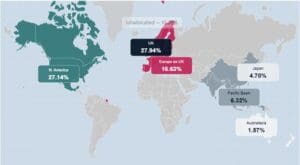
In addition to diversification across asset classes, the CDI Balanced Growth portfolio also allocates funds across all regions of the World. Whilst the Investment Committee are not constrained by geographic limits, the medium risk and balanced approach would ordinarily dictate that a higher proportion of the portfolio will be allocated across developed markets in North America, UK, Europe, and developed Asia.
As is the case in every CDI portfolio, the Committee aim to blend our preferred conviction investment style, through active managers, with passive funds that provide broad market exposure. As a result, the weighted fund charge of the portfolio is 0.35%, which is highly competitive for such a blended investment approach. In addition, the Committee continue to work with leading fund managers to access lower cost share classes where possible, with the aim of reducing the total portfolio cost of ownership.

Portfolio Performance

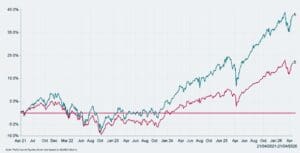
Measuring performance over a five-year period from 1st April 2021 to 1st April 2026, the CDI Balanced Growth portfolio (shown in green on the graph below) achieved a total return of 40.21%, which was more than double the 19.87% returned by the representative benchmark, the IA Mixed Investment Sector 20% to 60% shares (shown in red).
In addition to benchmarking the CDI portfolios against the IA sector benchmarks, we undertake a regular process which reviews our performance against managed portfolio services offered by leading UK portfolio managers. This process aims to ensure our services offer good value for money and performance remains consistently strong against real-world competitors.

Naturally, performance is the key metric on which we, and of course our clients, will focus; however, the level of risk taken to achieve returns is an important consideration. The FAS Investment Committee consider levels of volatility at each quarterly review stage, to ensure that they remain consistent with the levels displayed by the benchmark. Where changes are made to the portfolio each quarter, the impact of the change on the historic maximum drawdown and value at risk is carefully considered.

Practical applications for the CDI Balanced Growth portfolio

As the most popular CDI mandate, CDI Balanced Growth is an appropriate solution for anyone seeking capital growth wishing to take the middle ground between risk and reward. The portfolio’s diversification allows good levels of participation in rising markets, and allocations to investment grade corporate bonds and cash provide balance and aim to reduce drawdown in periods of market instability. This makes the Balanced Growth portfolio an ideal choice for pension funds, particularly in the pre-retirement phase, trusts and applications where capital growth over the medium term is sought.

Whilst not focused on income production, the asset allocation within the CDI Balanced Growth portfolio will lend itself to providing a modest level of income. The natural gross income yield generated by the CDI Balanced Growth portfolio is currently 3.3%, and therefore those who wish to focus on growth, with income as a secondary consideration, are also well catered for.

If you hold an existing investment portfolio – be it within a pension, Individual Savings Account (ISA) or General Investment Account – it is important to regularly review the performance you have achieved compared to alternative managers. Beyond performance, it is also useful to consider the level of risk to which you are exposed and to determine whether you are receiving good value for money. Our independent advisers can undertake an impartial performance review of an existing portfolio and provide an unbiased assessment of performance against the CDI portfolio range. Speak to one of the team to start a conversation.

Source: FE Analytics April 2026
Why tax-efficiency should not be your sole objective

By | Financial Planning

In the last edition of Wealth Matters, we explored the changes to tax legislation affecting investors, effective from 6th April 2026, together with practical steps you can take to reduce the burden of tax on your investment returns. Whilst tax-efficiency is an important aspect of any sound financial plan, it should not, however, be the primary driver of investment decisions. Indeed, focusing too much on the potential tax implications of a particular course of action can lead to poor decision making, introduce additional risk and potentially lead to missed opportunities.

Investment decisions

All of us would naturally prefer to receive tax-free investment returns and holding investments within an Individual Savings Account (ISA) provides exemption from income tax on dividends and interest and capital gains tax (CGT) on gains. The annual ISA allowance for stocks and shares investment stands at £20,000, although existing cash ISAs can be transferred to a stocks and shares ISA creating further room for growth in a tax-efficient manner.

Once investments exceed immediately available tax-free wrappers, some investors may choose to limit new investments to the annual ISA allowance and not make further investments, even if funds have been set aside for this purpose.

In most cases, history tells us that this could lead to a worse outcome, even considering the tax deducted on income and CGT on gains on assets held outside of a tax-efficient wrapper, as returns achieved from a diversified portfolio should exceed those available on cash deposit over the medium to longer term.

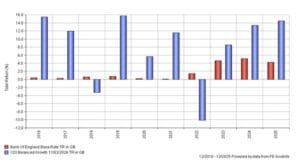
The chart below shows the return achieved each year by the CDI Balanced Growth portfolio, which adopts a medium risk approach (in blue) and the Bank of England Base Rate (shown in red). In eight out of the last ten years, the invested position has comfortably beaten returns on cash, with 2018 and 2022 being the two occasions when cash outperformed. Looking across the last ten years, rather than by calendar year, the cumulative additional gross total return achieved by the CDI Balanced Growth portfolio – as opposed to holding funds as cash – has been 95%. When you place the modest tax implications of investing outside of an ISA against historic outperformance, this serves as a useful reminder that tax considerations should not be a barrier to long-term investment.

Indeed, the tax treatment of investments held outside an ISA is often more forgiving than people expect. The Personal Savings Allowance covers the first £1,000 of savings income for basic rate taxpayers and £500 for higher rate taxpayers, and the Dividend Allowance covers the first £500 of dividend income received. These allowances can catch a proportion of the income generated within a General Investment Account. Beyond these allowances, the rate of tax applying to dividends in the hands of a basic rate taxpayer is 10.75%. Considering this another way, a basic rate taxpayer gets to keep almost 90% of dividend income that exceeds the Dividend Allowance.

As the annual ISA allowance resets each year, a practical solution is to sell investments held within a General Investment Account to fund future year’s ISA allowances. This will achieve greater tax-efficiency over time, whilst keeping funds invested.

CGT – look through a different lens

Another key investment decision where tax should not be the only consideration, is the decision to sell an investment outside of an ISA that will generate a CGT liability. It can be tempting to fall into the trap of choosing not to sell an investment, due to the CGT liability that would be generated; however, it can be helpful to look at the decision through a different lens. An individual who pays basic rate tax would keep 82% of the profits over and above the available CGT exemption and higher rate taxpayers would retain 76% of the profit over and above the exemption. Reinvesting the net sale proceeds into another investment, which then outperforms the investment that was sold, could lead to substantially improved returns, despite the tax bill incurred.

Pensions and Inheritance Tax (IHT)

One of the most frequently discussed areas of financial planning concerns unused pension funds. Under current legislation, pension funds sit outside of your estate for IHT purposes, and in situations when pension income is not needed, it has proved sensible planning to simply leave the pension undisturbed, as it can be passed to surviving spouse or family members without being subject to IHT. This position will change from April 2027, when unused pension funds are brought under the scope of IHT, which will lead to those impacted facing important decisions as to how to deal with existing pension funds. One option is to gift the value of the pension away to family members, and in the case of the Tax-Free Cash, which is usually 25% of the value of the pension up to the Lump Sum Allowance, this decision doesn’t carry any personal tax implications.

Beyond Tax-Free Cash, any pension income whether generated through an annuity or via Flexi-Access Drawdown, is potentially subject to Income Tax in the hands of the pension holder. Even if income is not needed, it may be sensible for a basic rate taxpayer to pay the 20% tax on pension income, and then spend or gift the income, rather than their estate suffer a potential liability to IHT on the unused pension, which is levied at 40%. Paying a smaller tax bill now to avoid a larger one later is a perfectly rational outcome, and a good illustration of why tax should inform decisions, not dictate them.

An impartial view

Whilst tax-efficiency is an important driver of investment returns, there are wider considerations that need to be taken into account. This is where holistic financial planning advice can help in taking an impartial view of your circumstances and provide an alternative perspective, which can help overcome inertia when it comes to taking decisions that create a tax liability. Speak to one of our experienced and independent financial planners to start a conversation.

Source: F E Analytics April 2026

12 years later, annuities are back

By | Financial Planning

As a means of drawing income in retirement, annuities have made a comeback, and for good reasons.

Source: ABI 

In 2014, the then Chancellor (and now podcaster), George Osborne, pulled a rabbit out of the Budget hat that nobody had seen coming. He announced the ending of the effective requirement for personal pension plans to be converted into an annuity in retirement.  Osborne’s ‘pension freedoms’ came as a shock to pension providers and a near-death experience to insurance companies active in the annuity market. Share prices in the life assurance sector plummeted as the inevitable question was asked, “Who will buy an annuity now?”

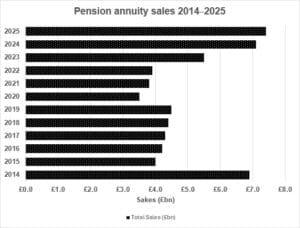
As the graph shows, pension annuity sales fell from nearly £7 billion in 2015 to £4 billion in the following year, and then flatlined until recovering in 2023. That was when annuity rates recovered from historically low levels, thanks to an increase in long-term interest rates. The latest annuity sales figures, for 2025, have recently been released by the Association of British Insurers (ABI), showing that £7.4 billion was invested last year – £0.5 billion more than in 2014. Adjust for inflation – about 40% cumulatively since 2024 – and annuity sales are still well down in real terms.

The ABI data revealed some interesting trends:

  • Sales of annuities with purchase prices of over £250,000 rose by 31%, while sales above £500,000 increased by 54%.
  • There was an 8% rise in sales of annuities to those aged 70 and older.
  • Escalating annuities, under which payments increase each year, attracted a tenth more sales than in 2024, accounting for one in five of all annuity sales.

The jump in higher value sales could be the first signs of a response to the plans to bring unused pension pots into the ambit of inheritance tax (IHT). From 6 April 2027, if death occurs on or after age 75, the effective tax rate on the unused pot could be 64% (40% IHT and then 40% income tax) or more. Faced with that level of tax and the associated complexities of managing income drawdown and the estate administration, an annuity offering guaranteed income for life (and no death benefit) has clear attractions. For a 65-year old, at present that income could start at over 5.25% and rise in line with the retail price index (RPI) inflation each year.

The value of your investment and any income from it can go down as well as up and you may not get back the full amount you invested.

Tax treatment varies according to individual circumstances and is subject to change.

The Financial Conduct Authority does not regulate tax advice. 

New Tax Year, New Rules

By | Financial Planning

The start of a new tax year heralds further changes to the UK tax landscape, affecting dividends, Inheritance Tax, and tax relief on certain investments. Investors, business owners, and landlords need to be aware of the changes, which naturally bring the tax efficiency of investments into sharp focus.

The changes in detail

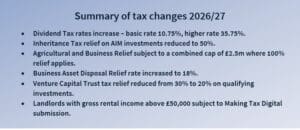
Perhaps the most immediate change investors will notice is that Dividends are now subject to higher rates of tax in the hands of basic rate and higher rate taxpayers. Both rates have increased by two percentage points, with basic rate taxpayers now paying 10.75% on dividend income and a rate of 35.75% applying for higher rate taxpayers. For those who pay income tax at additional rate, the top rate of 39.35% remains unchanged.

With the Dividend Allowance remaining static at just £500, even modest portfolios held outside of a tax-efficient wrapper, such as an Individual Savings Account (ISA), are likely to incur a higher tax charge.

It is not only investors who need to consider the hike in dividend tax rates. Company Directors may well need to reconsider the most efficient way to extract profits from their business.

Following changes announced at the end of 2025, Agricultural Relief and Business Relief is now subject to a combined cap of £2.5 million, up to which 100% Inheritance Tax (IHT) relief can be claimed. Qualifying assets with values above the cap will only benefit from 50% relief (in other words an IHT rate of 20%) which stands in marked contrast to the position before 6th April when an unlimited value of assets could qualify for either Agricultural or Business relief. The combined £2.5m allowance for qualifying assets is transferable between spouses and civil partners, which is a welcome change from the original draft legislation announced in 2024, and provides the opportunity to consider the ownership of assets.

Shares quoted on the Alternative Investment Market (AIM) will now only benefit from 50% relief making the effective IHT rate 20% on these assets. As a result of these changes, those holding AIM investments may wish to rethink whether accepting a lower rate of IHT relief is significant justification for continuing to hold AIM investments or consider alternative investments that benefit from relief.

The sale of business assets, which qualify for Business Asset Disposal Relief (BADR) will now attract a rate of 18% on gains, an increase of 4% on the rate which applied in 2025/26 and significantly above the 10% level which applied before 2025. The lifetime limit for capital gains which qualify for BADR remains at £1m in the new tax year.

Income tax relief on Venture Capital Trust (VCT) investments has been cut from 30% to 20%, which represents a blow to smaller businesses, who rely on VCT funding, and skews the ratio of risk and reward when investing in fledgling unquoted UK businesses. At the same time as reducing the tax relief, other VCT rules have been relaxed, which allow larger and more established companies to apply for VCT funding. Over time, these changes may well improve the quality of VCT portfolios and reduce risk. In the intervening period, we wait to see the impact of the reduction in income tax relief on the ability of VCT managers to successfully raise funds.

From 6th April 2026, landlords with gross annual rental income exceeding £50,000 are required to maintain digital records and submit quarterly updates to HMRC, under Making Tax Digital, in addition to completing their annual tax return. The scope of the regime will broaden significantly in the coming years. Landlords with gross rental income above £30,000 will fall within its requirements from April 2027, with the threshold reducing further to £20,000 from April 2028.

Practical steps to take

The changes introduced from 6th April will see higher rates of tax applying to dividends and allowances reduced. There are, however, practical steps you can take to be more tax efficient.

The simplest step is to make sure that you use all available tax allowances. The annual ISA allowance remains at £20,000 for all investors in the 2026/27 tax year and dividend income earned from investments held within an ISA is tax-exempt. Whilst the Dividend Allowance may well be modest at just £500, married couples can arrange their investments held outside of a tax wrapper carefully to ensure that both allowances are used.

Looking further ahead, the income tax rate on savings income is due to increase from April 2027, and pensions will enter the scope of IHT from the same date. Planning now, rather than reacting later, can help build greater tax-efficiency and strengthen your financial position.

The benefit of personalised advice

The new tax regime has introduced further changes that investors and business owners need to consider. Whilst we have set out practical steps you can take, personalised and individual financial advice can deliver significant benefits. Our experienced advisers at FAS can consider your personal financial situation and provide independent advice on effective ways both to reduce your tax burden and ensure your investments, pensions and other arrangements are professionally managed and reviewed.

If you would like to discuss how the changes affect you, we would be delighted to start that conversation.

Don’t leave retirement planning too late!

By | Financial Planning

Most of us understand, in a general sense, that saving for retirement is important. Keeping existing retirement savings – such as pensions – under regular review is a sensible step that everyone should take, irrespective of their stage of life.

The years immediately preceding retirement, however, demand much greater attention. Decisions made during this period are among the most complex and consequential, as they often have financial implications that last for the remainder of your life.

It is important to remember that your date of retirement is never fixed, and in some instances may arrive sooner than anticipated due to unforeseen circumstances. Redundancy, ill health, or a change in family circumstances can all bring retirement forward unexpectedly. Those who have already reviewed their position, consolidated their plans, and considered their options are far better placed to adapt than those who had assumed they had more time.

Take pension reviews to the next level

In the years before your intended retirement date, it is essential to understand your existing pension provisions. Obtaining up-to-date valuations and collating multiple pensions that most people accrue during their working life is an obvious first step to take. Fully understanding the pension income options at retirement offered by each plan is equally important. Many older style arrangements may not be able to offer the flexibility provided by modern pension contracts, and reviewing these at an early stage can help identify plans with limited options and allow timely action if necessary.

As retirement approaches, it is also important to review the investment strategy adopted within each plan. If investment markets suffer a downturn in the period immediately before you retire, this could have a lasting impact on your retirement income if your portfolio is not positioned to manage that risk.

To protect against this, most workplace pensions now adopt a lifestyle investment approach, which automatically reduces the level of risk within the investment strategy as you near retirement; however, this strategy is prescribed and may even be detrimental to longer-term pension income if the strategy does not fit your plans.

For example, a strategy that aims to purchase an annuity at retirement would have a very different risk profile in the lead up to retirement than a strategy designed for transition into Flexi-Access Drawdown at retirement. Furthermore, the schedule of risk adjustment and scheme’s normal retirement date may not align with your plans. This could result in the portfolio either carrying excessive risk in the years approaching retirement, or conversely holding too little in equities, leading to missed growth potential.

Defined Benefit pensions – call to action

The need to review pensions well in advance of retirement is not limited to those with personal pensions. If you hold a Defined Benefit pension — sometimes called a final salary scheme — the rules of the scheme will largely govern what you receive and when; however, the administration of these pensions can be slow, and in some cases has become significantly slower in recent years.

Some public sector pension schemes carry substantial backlogs, which could lead to delays in receiving Tax-Free Cash and pension income after applying to take benefits. This has been particularly acute within the Civil Service Pension Scheme, where Capita took over administration of the pension scheme in December 2025. Inheriting an extensive backlog, the company are aiming to work through outstanding pension claims as quickly as possible, although delays persist. The Government have indicated that pension members experiencing unacceptable delays may be entitled to compensation; however, this may be of little immediate assistance to those without an income during the intervening period.

State Pension applications

The State Pension sits at the foundation of most people’s retirement income. From 6th April 2026, the full new State Pension is currently worth around £12,547 per year, and under the triple lock it is protected to increase each year by the highest of inflation, average earnings growth, or 2.5%. It is, therefore, worth protecting your entitlement to it carefully.

Practical steps to take include checking when you reach State Pension Age and reviewing your National Insurance record in advance of retirement, to identify any gaps. These gaps could be filled to help you reach the 35 qualifying years of contributions needed to benefit from the full new State Pension.

Many reaching State Pension age do not appreciate the need to apply for the State Pension payments to commence and assume the payments will automatically start when reaching State Pension age. As there is also the option to defer payments, individuals must actively apply to start receiving the State Pension. An invitation letter is sent out by Government approximately four months before reaching State Pension age, providing details of the online and telephone application routes.

Advice is key

Deciding when to retire is a daunting proposition as it marks the end of one chapter in your life and the beginning of another. Financial decisions taken at this juncture require careful consideration, and as outlined above, taking control of the process at an earlier stage than you might expect can yield substantial benefits. Given the importance of making the right decision with retirement savings, independent financial planning advice can really add value at this crucial stage. Our experienced advisers can take a holistic view of your plans and help you take the most appropriate action to meet your goals in retirement.

If retirement is on the horizon — whether that means two years away or ten — now is the right time to start getting your plans in order. The earlier you begin, the more options remain open. Speak to one of the team to start a conversation.