

One of the key decisions facing an investor wishing to make a lump sum investment is the timing of that decision. Moving from a position where funds are held as cash, into global markets that fluctuate daily, is a significant decision, as it sets the benchmark against which all future returns will be measured.
Where investments are made on a regular basis, for example via monthly pension contributions, the investor benefits from “pound cost averaging”. As markets fluctuate over time, the regular purchase each month produces an average entry point, smoothing investment returns and taking away the need to reach a decision.
The investor with a lump sum to invest doesn’t enjoy the benefit of a pre-determined investment schedule and is faced with taking a decision as to when to invest. Conventional investment wisdom would dictate that a rational investor should maximise the time that investments are held, and therefore the simple answer is to make the lump sum investment at the earliest opportunity, so that the investment can begin generating returns as soon as possible.
Delaying an investment purchase can potentially lead to an opportunity cost in the form of missed returns. An investor who delays, waiting for a lower price or a calmer period, gives up time that the money could otherwise have spent growing. This opportunity cost is easy to underestimate, because the market’s best-performing days are difficult to predict and often occur shortly after its worst days.
How phasing works
There are, however, various scenarios where drip feeding funds into markets over time becomes an appealing option.
For example, an inexperienced investor may prefer to dip a toe into the investment water first, to test the temperature, before committing the full investment amount. This allows the investor the time to pause and reflect as their confidence in the investment process grows. Alternatively, an investor may have a significant lump sum to invest, relative to their overall wealth, which may well justify a more cautious approach, given the potential monetary impact of a poorly timed entry in absolute terms.
Market conditions can also influence the decision to invest in full or drip feed funds into markets. In periods of higher market volatility, global turmoil or following a sustained market rally, investors may question whether investing a lump sum in a single tranche is the correct way forward.
Splitting a lump sum investment into smaller amounts invested over a period is known as “phasing”. This converts the lump sum investment into a series of smaller investments, made at regular intervals over an established timeframe, so that the same amount is invested at each point in the phasing process. As prices and values will be different from month to month, each purchase buys a different number of shares in a fund or series of funds, smoothing the entry into markets.
Phasing can work in an investor’s favour, if markets fall during the phasing process. At each investment point, the phased investment would buy a greater number of shares as prices fall, leading to a better outcome than if the lump sum was invested in a single transaction. On the other hand, rising markets will mean that each phased purchase buys fewer shares, leading to a worse outcome than would be the case using a single purchase point.
The long- and short-term outcome
Phasing can prove beneficial in periods of market turmoil, or where the investor is inexperienced; however, when considering investment returns over the longer term, the impact of phasing through the toughest market conditions may only modestly impact returns achieved, since it is an investor’s time in the market, rather than timing the market, that has the greatest influence on performance.
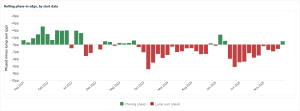
Take the following example, which shows the outcomes of a phased entry into the CDI Balanced Growth portfolio, over a six-month period, compared to immediate investment, for each month since September 2021. Where the bar is green, the investor would have benefitted from the phased approach. Conversely, bars shown in red indicate where phasing would produce a worse outcome than immediate investment.
The chart clearly shows that a phased approach would have been advantageous during much of 2021 and 2022, whereas investing fully would have produced a better outcome for almost the entire period from October 2023 to March 2026.
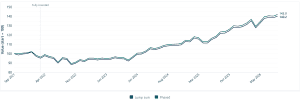
Even through the periods where phasing produced a short-term outperformance, the effect on portfolio performance over the longer term may still be marginal. The graph below shows the relative performance of an investor who fully invested in the CDI Balanced Growth portfolio in September 2021, compared to an investor who phased their investment over six months from September 2021 to March 2022. This period coincided with the outbreak of conflict between Russia and Ukraine and led to a sharp pullback in equity markets.
Whilst the phasing would have proved beneficial in the early stages, the difference in long term performance, when comparing the phased and immediately invested position, only amounts to 1.7% over a five-year period.
The power of independent advice
Our analysis shows that an investor with a long time horizon for investment may be best served by pressing ahead with an investment decision, rather than trying to time the entry point. In our experience, however, phasing money into markets can prove an attractive option where an investor feels more comfortable taking this approach, where the lump sum is significant or market conditions are likely to prove volatile in the short term.
The timing of entry into markets is a single variable in a range of factors that dictate the success of an investment strategy. Asset allocation, investment fund selection and portfolio diversification all exert a significant influence on returns achieved over the longer term.
As each individual’s needs and objectives are different, our experienced advisers take the time to talk to our clients about risk and volatility in detail, enabling clients to reach an investment decision with which they are comfortable. Speak to one of the team to start a conversation.
Source : FE Analytics September 2026