


Technology stocks have, once again, been the driving force behind the strong market returns over recent months. The rapid expansion of Artificial Intelligence capability and oversized spending on necessary infrastructure has fed into a broadly positive set of mid-year earnings reports for the largest US tech giants, supporting further recent gains.
Investors remain optimistic that technology stocks can continue to deliver earnings growth that exceeds expectations, pushing the market capitalisation of the sector ever higher within recognised indices. The popularity of passive investment strategies, that simply track the performance of an index, is also reinforcing this trend. If you buy a fund that tracks the S&P 500 index, the broadest measure of the US stock market, you are currently allocating around 30% of your portfolio to the technology sector. In contrast, the second largest sector allocation, financials, accounts for just 12% of the index weight.
Whilst investor confidence around technology remains high at present, a portfolio built around one sector carries a specific type of risk. If that sector falls out of favour, there is nowhere else for returns to come from. A disappointing set of earnings data from one of the largest technology stocks could have a knock-on effect on other stocks in the sector, and given that valuations are demanding, this could lead to weakness across the sector.
We feel the current sector concentration within leading indices serves to strengthen the importance of sector diversification when constructing a well-balanced portfolio.
Sector diversification
The easiest way to reduce concentration risk within a portfolio is to spread capital across different sectors of the economy, as this reduces the dependence on a single part of the market. Allocating to sectors such as financials, healthcare, utilities, energy, industrials, and consumer staples changes the shape of a portfolio’s risk and return profile, as these sectors respond differently to the same economic conditions.
For example, technology and consumer discretionary shares tend to perform well during periods of economic growth and low interest rates. Healthcare and household goods tend to hold up better during downturns, because demand for medicine and essential spending does not disappear in a recession. Energy and utilities companies often respond to commodity price cycles that have little to do with the broader economy.
Reducing portfolio volatility
A sector experiencing rapid expansion, such as technology, is likely to see periods of higher volatility (i.e. a measure of how much and how quickly an investment moves higher or lower) as investors adjust their assumptions for future growth regularly following quarterly earnings reports. When investors question valuations, stocks priced on high earnings multiples can suffer sharp pullbacks. Investors who therefore fail to diversify their portfolios adequately can leave themselves vulnerable to accepting higher levels of volatility than is necessary.
In the case of the tech sector, a further factor is the popularity of stocks such as Nvidia and Apple amongst retail investors, who are more likely to take a short-term approach to investment than financial institutions.
The chart below plots the return and associated volatility of the FTSE All-World Technology sector benchmark (shown in red) compared with selected other FTSE All-World sectors, over the last 12 months. It demonstrates the strong returns achieved by the technology sector, but also clearly shows the significantly higher level of volatility seen over the last 12 months compared to more traditional sectors, such as banks, financials, and pharmaceuticals.
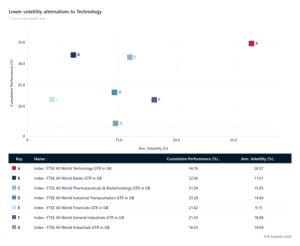
Investors naturally seek the best returns they can from a particular market; however, the level of risk taken to achieve returns is an important consideration. Spreading a portfolio across sectors with lower volatility reduces overall risk. Combined with allocations to fast-growing sectors, such as technology, keeps the portfolio balanced.
Our approach to sector allocation
When constructing the CDI portfolios, the FAS Investment Committee aim to ensure that good levels of diversification are maintained, not only across different sectors of the economy, but geographic regions, too. The investment approach used across the range of CDI portfolios is to blend passive funds, where appropriate, with actively managed funds, which the Committee feel offer the best prospects for long-term outperformance.
Within the actively managed equities funds, the Committee have specifically selected fund managers that take a high conviction approach, therefore avoiding active funds that simply look to match the sector weights of the index or market in which they invest.
The Committee have also increased allocation to equity income funds across the CDI range, in both active and passive form. Stocks that are likely to appear in an equity income fund generally provide a strong and rising dividend yield and are cash generative. The equity income funds recommended by the FAS Investment Committee have lower levels of exposure to technology stocks, providing a useful foil to the tech-laden index funds. As a result, overall levels of volatility displayed by the CDI portfolios remain within acceptable limits.
The need to review
Whilst portfolio diversification is a proven investment theory, it does not remove the need to consider the investment strategy adopted regularly, to ensure that the investments held remain appropriate given the prevailing economic and market conditions. Where strong growth is achieved from one sector of the market, this can distort the portfolio allocation and lead to additional risk, should market sentiment shift and a sector rotation occur.
The CDI discretionary managed portfolios are reviewed and rebalanced regularly, with a formal portfolio review occurring at least four times a year. Furthermore, the FAS Investment Committee can undertake an ad hoc portfolio review if market conditions dictate, and have done so on numerous occasions over recent years.
If you hold an investment portfolio that has not been regularly reviewed or wish to invest via an actively managed and conviction-based investment approach, then speak to one of our experienced advisers. We can assess existing investment portfolios and provide tailored solutions on both an advisory and discretionary basis.