
We have taken the opportunity to closely review the range of CDI discretionary managed portfolios over recent weeks, focusing on strategies designed to suit investors who are happy to accept medium levels of risk, or indeed wish to invest more defensively with a focus on income. This week, we take a closer look at a more growth-orientated and equity heavy strategy, namely CDI Progressive Growth.
The key to long term performance
When considering the long-term performance of different asset classes, equities have historically demonstrated superior returns to cash or government bonds. According to data collated within the Barclays Equity-Gilt Study, which analyses UK investment returns from 1899, equities have historically outperformed cash nine times out of ten over any given ten-year period over the last 125 years. Once you add in the compounding effect of growth, and the power of reinvested dividends, there is clear evidence that supports the benefit of holding higher weights in equities, when seeking capital growth over the longer term.
Equity investment does, however, come with a trade-off, in the form of increased volatility. Whilst global markets have performed well over the last two years, we only need to look back to 2022 (Russia-Ukraine), 2020 (Covid), 2006-8 (Great Financial Crisis) and 2000-2 (Dot Com Bubble) as recent examples where global equity markets have suffered a sharp temporary pullback.
By introducing an element of diversification into other asset classes, which historically produce less volatility, the overall risk within a portfolio can be reduced. For those investors happy to accept medium to high levels of investment risk, and hold most of their portfolio in equities, the CDI Progressive Growth portfolio may be an ideal solution.
CDI Progressive Growth
The CDI Progressive Growth portfolio is designed to provide a broad diversified exposure to global investment markets, by investing in a range of active and passive funds. The aim is to produce capital growth over the longer term.
As with the other CDI mandates, the portfolio is constructed by the FAS Investment Committee, who consider funds from the whole of the market. Using quantitative filters, the available fund universe is narrowed to a select range of funds, which are then rigorously assessed before being considered for inclusion.
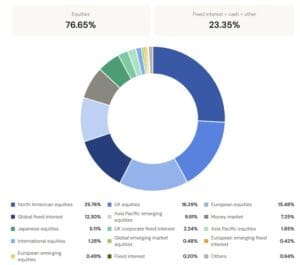
The CDI Progressive Growth portfolio can hold a maximum allocation of 85% in equities; however, the Committee have taken a tactical decision to reduce exposure to US equities since last August, which results in the portfolio holding a current equity allocation of 76%. This allocation is spread across different geographic regions, with 25% currently held in US equities, 16% in UK equities and 15% allocated to both the European and Asia Pacific (including Japan) regions. The balance of the portfolio is held in global fixed income, with a current allocation of over 7% in cash. Usually, the portfolio would run with cash levels of around 2%; however, the Committee have taken the tactical decision to hold higher weights in cash, amidst the current global uncertainty. The graphic below demonstrates the extent of the diversification within the portfolio.
All CDI portfolios adopt a blended approach, holding allocations to actively managed funds where the Committee feel additional returns can be generated, and passive exposure where appropriate. CDI Progressive Growth is no exception, holding a broadly equal split between both investment styles. As a result, the weighted fund charge of the portfolio is currently 0.36% per annum, which is highly competitive for a blended, conviction-style investment approach.
Portfolio Performance
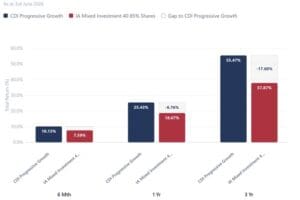
The CDI Progressive Growth portfolio has consistently outperformed the representative sector benchmark, the Investment Association Mixed Investment 40-85% shares sector, over the short, medium, and longer term, as demonstrated in the chart below. Whilst performance is, of course, of key importance, the FAS Investment Committee also ensure that the level of volatility and risk within the portfolio remains broadly in line with the sector average.
The FAS Investment Committee regularly review the performance of the CDI portfolios against managed portfolio services offered by leading UK portfolio managers. When analysing a client’s existing arrangements, we can very often demonstrate performance that is consistently strong when measured against industry peers and also offers good value for money.
CDI Progressive Growth in action
The CDI Progressive Growth portfolio may be an appropriate option for longer-term investments for individuals and trustees, who are comfortable to accept a degree of volatility. The modest allocations to fixed income provide some diversification, which separates the portfolio from a pure equity growth strategy.
We have found the most common application for the CDI Progressive Growth portfolio is where individuals transfer existing pensions or investments, seeking improved performance.
Portfolio allocations of around 80% in equities are common amongst many default pension strategies and likewise, investment managers often gravitate towards a similar level of equity exposure for their balanced and medium risk strategies. By transferring existing arrangements, clients find that CDI Progressive Growth closely matches the asset allocation of their old plan, adopting a similar level of risk as they did prior to transfer.
If you hold existing pension savings, or investments within an Individual Savings Account (ISA) or General Investment Account, benchmarking not only performance, but risk, drawdown and costs on a regular basis can help identify whether your investments are on track to meet your goals.
Our independent advisers can help in this process, by undertaking an impartial review of an existing portfolio and provide an unbiased assessment of performance against the CDI portfolio range. Speak to one of the team to start a conversation.