


Incredible though it may seem, we are already halfway through 2026. In this edition of Wealth Matters, we will review a largely positive – albeit volatile – first half of the year and look at the key factors that are likely to shape market direction over coming months.
First Half Performance
Global equities have once again faced geopolitical headwinds during the first six months of this year. Despite the potential for the global economic outlook to be derailed by events in the Middle East, major World indices have continued to make forward progress. The S&P500 index of leading US shares rose by 9.55% over the first six months, and European bourses made modest progress. Asia-Pacific markets generally outperformed, with the Nikkei 225 index up almost 40% over the year to date.
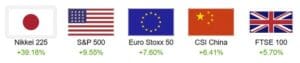
Performance to 30th June 2026 – source F E Analytics
Two key themes have shaped market direction so far this year. The outbreak of hostilities between the US/Israel and Iran dented the positive sentiment and sent energy prices rapidly higher. Brent Crude prices surged to $117 USD a barrel, levels not seen since the Russian invasion of Ukraine in 2022, and together with the closure of the Strait of Hormuz, limited oil supply and threatened to push inflation across Western economies significantly higher. The cessation of direct military action has moved oil prices to a more comfortable level, although shipping traffic through the region remains interrupted. Most commentators expected a series of base interest rate cuts over the course of this year. This narrative was quickly derailed by the conflict, and inflation is expected to remain elevated throughout the remainder of 2026.
The other key driver has been significant capital expenditure in the technology sector, as companies race to build the necessary infrastructure to support the increasing use of Artificial Intelligence (AI). The demand for processing power has led to a surge in borrowing by major tech giants, with the spending helping to propel semiconductor stock prices sharply higher. Investors have, at least to date, accepted the higher debt levels as a necessary step to support future growth.
Reasons to be cheerful
Markets are driven by confidence, and the resilience shown in the face of another geopolitical shock earlier this year helps support a broadly positive outlook. The rapid expansion of AI shows no signs of slowing in the short-term, although valuations are becoming stretched in places. The market debut of SpaceX – the largest initial public offering in history – was generally well supported and with Anthropic and Open AI set to float over coming months, we expect investor interest in the tech sector to continue.
The AI trade will continue to drive other sectors of the economy over the coming months. The power demands of AI infrastructure are significant and provide growth opportunities in traditional and alternative power generation. Looking further ahead, expect investor focus to shift to the wider benefits of AI across many sectors of the economy, as workflow processes are streamlined, and robotics and automation are more widely implemented.
Despite the impact of higher inflation, the Trump-led appointment of Kevin Warsh as the Federal Reserve chairman may help sustain the market optimism. Whilst rate cuts may be off the cards for the time being, markets anticipate Warsh will look to begin cutting rates as soon as it is prudent to do so, possibly in early 2027.
…and reasons to be fearful
Given the positive performance seen over the last 2 ½ years, it would be unreasonable to suggest any leading global equity market offers good value at current levels. Valuations in some sectors are demanding, and investors now fully expect major tech names to not only match but beat earnings expectations consistently. Disappointment could lead to a sharp de-rating and due to the sheer size of the largest companies by weight, push indices lower.
The fragile ceasefire in the Middle East appears to be holding – just. Tensions remain high, and any resumption of major military action is likely to dampen investor confidence. Even if activities in the region move to more normal levels, oil infrastructure may take many years to replace, and reserves will need to be replenished. Oil prices may, therefore, remain anchored around current levels for some time to come.
US domestic political risk is likely to increase as we enter the final months of 2026. The US mid-term elections may be challenging for the current administration, given the cost-of-living pressures many Americans face. The February ruling that invalidated the sweeping tariffs introduced by President Trump in April 2025 has led to a pivot towards more targeted measures; however, recent threats by Trump to impose tariffs on countries that levy a digital services tax show that tariff risk has not disappeared and could weigh disproportionately on multinational technology firms with significant European revenue.
The importance of diversification
After a strong start to 2026, the second half of the year may well see the positivity around AI dampened by wider concerns around the strength of the global economy. At an index level, markets would do well to advance significantly higher from current levels in the short term, and the disproportionate index weight held by the largest stocks is a specific risk that those who choose to simply “buy the market” would be wise not to ignore.
As always, the prevailing conditions produce opportunities where value exists. Defensive sectors of the economy, where stocks offer positive cash flow and a strong dividend yield, look appealing. Asia Pacific markets continue to tell a strong growth story, underlining the importance of global diversification.
A nimble portfolio strategy that seeks out areas of value appears well placed in the current conditions. At FAS, our investment approach focuses on active fund managers that can add value, combined with selected broader market exposure. We would suggest the halfway point through 2026 is an ideal time to review how your portfolio is positioned for the months ahead. Our expert advisers can undertake an independent review of an existing portfolio and make suggestions to adjust strategy where appropriate. Speak to one of the team to start a conversation.
Source: F E Analytics July 2026