

Monthly Archives

February 2026

Don’t fall victim to an investment scam

By | Financial Planning

Over four in every ten criminal offences carried out in the UK each year involve financial fraud. Despite the financial services industry taking steps to crack down on financial fraud over recent years, our growing reliance on technology is opening new doors to would-be scammers, who are turning to ever-more sophisticated methods, which can be hard to spot.

There are, however, common-sense steps you can take to help protect yourself falling victim to an investment or pension scam.

Ways to protect yourself

Financial fraud can take many forms and often start with an unsolicited contact, via a call or text message, or on social media. So-called Phishing scams appear to come from a legitimate source, such as H M Revenue & Customs, Amazon, PayPal or a bank, suggesting you may be entitled to a refund, or have tax to pay. Scammers may also make unwanted calls, purporting to be from a legitimate organisation, to get you to part with your personal details.

You should always treat any unsolicited contact with suspicion. If you’ve been called by someone claiming to be from your bank or another financial institution, end the call and then phone the company back, ideally from another phone. This is important, as scammers can keep the line open if you call back from the same phone. You should never disclose passwords, PIN numbers or bank details over the telephone. Likewise, think carefully before you click on a link contained within a text message or email, as this could direct you to the scammer’s website, rather than the genuine site. If in doubt, visit the legitimate website directly, instead of clicking on a link.

The worrying rise of investment scams

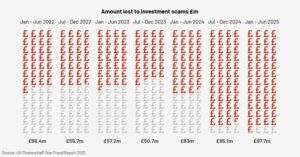
According to the UK Finance Fraud Report, the amount of money lost to investment scams alone increased to £97.7m in the first six months of 2025. These grim statistics are a timely reminder of the need to remain vigilant against investment fraud. Victims of investment scams may not only face financial consequences – becoming a victim of financial fraud can also lead to considerable emotional and psychological harm.

Investment scammers are increasingly turning to social media to carry out their crimes. Advertisements and pop-ups offering high or guaranteed investment returns are becoming increasingly commonplace, as is the use of fake celebrity endorsements, which aim to lend a sense of credibility to the scam.

Many of these scams involve cryptocurrency, but may also feature precious metal investments, or mainstream stocks and shares. Such schemes often guarantee high returns with little risk and sometimes suggest an investment opportunity is only available for a limited period, creating a sense of urgency for the victim to act. It is important not to feel rushed into making a financial decision and always take time to think about whether to take up an offer. This will give you time to seek independent advice before reaching a decision.

Another tactic used by criminals is to create an investment website that looks very similar to an established brand or service. Such “cloned” websites are cleverly designed to fool the user into thinking they are dealing with a legitimate firm. The Financial Conduct Authority (FCA) maintains a list of “cloned” firms on their website, where you can check whether a fake firm has been previously reported for setting up a fraudulent operation that uses the name, address or other details of a legitimate firm.

Pension scams

Scams involving pensions are also becoming more prevalent. According to Action Fraud, total losses from pension scams in 2024 exceeded £17m, with the average victim losing over £34,000. Pension scams often involve the use of fake websites, or cold calls, and attempt to get the individual to transfer their pension savings with the promise of high returns, often using unregulated investments such as overseas property or a high-risk venture in the UK.

Other pensions scams involve the promise of early access to pension savings. The earliest you can access pension savings in the UK is age 55 (rising to 57 from 2028), and earlier access is only possible under strict conditions such as serious ill-health or a terminal diagnosis with a life expectancy of less than 12 months. So-called “pension liberation” scams falsely claim that you can access your pension savings before the age of 55, and victims not only often lose their pension savings, but become liable to significant tax penalties.

Check if it’s real, before you seal the deal

You can help protect yourself from investment fraud by checking who you are dealing with. The FCA Financial Services Register lists details of firms and individuals who are authorised to provide investment and pension advice. To increase awareness, the FCA recently launched a nationwide campaign under the banner “Check if it’s real, before you seal the deal”, using television, radio and media advertisements.

Trust your instincts

There are simple steps you can take to avoid falling victim to an investment scam. Any unsolicited contact from a financial services provider or other organisation should be treated with a high degree of suspicion. Take time to consider any action carefully and don’t feel rushed into making a decision to part with your funds or financial information. Furthermore, be very wary of online adverts offering the promise of high returns. Trust your instincts, and if something seems suspicious, report it to Action Fraud, the UK’s national reporting centre for fraud and cybercrime.

Why independent advice adds value

By | Financial Planning

We firmly believe the value of financial advice has never been greater. Whether trying to navigate global markets in an ever-changing World, or tackling an increasingly complex tax regime, good quality financial advice can deliver clarity and help you build a cohesive financial planning strategy, so you can face the future with confidence.

Selecting the right financial adviser can, however, be daunting, and one of the first decisions that needs to be reached is whether to use an independent or restricted adviser.  Independent financial advisers are not tied to any specific financial products, providers or investment institution, so they can offer impartial advice tailored to their client’s needs. In contrast, restricted advisers can only recommend certain products and solutions from a very limited range of options, and in some cases, will only be able to recommend products from a single provider.

Both independent and restricted advisers must have achieved the requisite level of qualification and be properly authorised. Taking advice from a restricted adviser may, however, lead to missed opportunities due to the lack of freedom to choose investment solutions and funds from across the marketplace.

A changing landscape

The frequent changes in legislation seen over recent years are leading many people to consider a change of course within their financial plans. With unused pensions falling within the scope of Inheritance Tax from April 2027, Trusts and other planning tools such as investments that aim to qualify for business relief, are being used more readily to help families pass down wealth tax-efficiently between generations. More individuals are paying greater levels of Income Tax, reinforcing the importance of tax-efficiency using tax wrappers, and investments that provide tax relief, such as Venture Capital Trusts (VCTs).

To meet the changes in legislation, product providers are creating new solutions. Using an independent adviser will mean that an adviser is free from constraints and can select from these products if they fit a client’s needs and objectives; however, a restricted adviser may be unable to recommend the product if it is not within the panel of options permitted through the restricted advice process.

Another key advantage an independent service has over a restricted adviser is the freedom to select platforms, funds and product providers from across the marketplace, which can also ensure that solutions are cost-effective. As providers launch new services, and existing products are revamped, an independent adviser can actively compare options to aid cost effectiveness.

Investment options

One of the key differences between restricted and independent advisers is the breadth of choice when constructing investment portfolios. Restricted advisers generally build their investment proposition from a prescribed range of funds, which are generally managed by a centralised investment function. Whilst many of the major restricted advice firms use external managers for their investment solutions, the adviser will only be able to choose investments from the pre-selected available panel of funds.

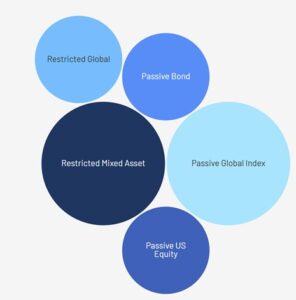
This proves to be an efficient solution for the restricted adviser firm but may not be for the client. Due to the limited range of options offered by restricted advisers, the fund sizes in the most popular restricted mandates have increased to significant proportions. The visualisation collates the largest collective investment funds available to UK investors, which each have more than £20bn under management, and demonstrates the size of the most popular restricted funds, the largest of which now stands at over £43bn.

A major drawback of such large mandates is that the portfolio will largely be passive in nature, with little room for outperformance that can be generated by active management. Furthermore, smaller fund houses, with expert managers and a strong track record of performance, would simply be out of reach of the largest restricted advice propositions.

By way of contrast, an independent adviser can select investment funds from across the range of available funds without restriction. This means the investment solution will be constructed from research and analysis which considers a much broader range of potential options, leading to a more nimble proposition that can readily adapt to changes in market conditions.

Making the most of our independent status

The financial services industry continues to evolve, resulting in the creation of new solutions, and existing products are updated regularly. As an independent firm, we are free to access and recommend such solutions to our clients.

Our Investment Committee undertakes regular reviews of available platform services, and we use independent and external research that enables us to select the right option that is tailored to our client. The Committee also uses expert external analysis to review esoteric products such as VCTs and Enterprise Investment Schemes, which may not be offered by a restricted firm.

Investment returns are directly influenced by portfolio construction and investment selection can make a significant difference to the cumulative returns achieved over the longer term. Our Investment Committee carries out research on all funds available to UK investors on a quarterly basis, leading to an approach that seeks to find the “best of breed” without restriction.

We are proud of the independent holistic advice service that we provide to our clients, and our advice process takes full advantage of our independent status, aiming to tailor the most appropriate financial solution to every client circumstance. Many adviser firms have taken the decision to adopt a restricted approach, which may well have been the right choice for the firm in question, but not necessarily for the client.

Speak to one of our experienced and independent advisers to discuss your financial plans and review your existing arrangements.