

Monthly Archives

December 2025

Reflections on another positive year

By | Financial Planning

After enjoying a positive year in 2024, investors would have been wise to expect more volatile conditions in 2025. Despite periods of significant uncertainty, major asset classes have produced strong returns over the year to date, with global stock market indices standing close to all-time highs at the time of writing. Fixed interest investments have enjoyed a strong year too, buoyed by expectations of continued monetary easing. In the final Wealth Matters of 2025, we consider the factors that have contributed to the strong performance.

Rallying markets

2025 got off to a slow start. January saw market jitters over the release of an Artificial Intelligence (AI) model by Chinese firm DeepSeek, which led to sharp falls in the value of leading US tech names. The announcement of sweeping tariffs by the US administration in April led to a sharp global sell-off, as investors grappled to understand the implications for the global economic outlook. Market volatility rose to the highest level since the peak of the Covid-19 pandemic but quickly subsided following more conciliatory noises from Washington.

The second half of the year has seen a rally in virtually all asset classes, with global equity indices buoyed by strong earnings reports from US tech giants, and investor hope that the AI boom will see companies continue to beat profit expectations. Investment in AI has been a major contributor to US economic growth over the last 12 months, although the weakness elsewhere increases the risk that a small deceleration in the outlook for AI profitability could lead to weaker economic growth in the medium term.
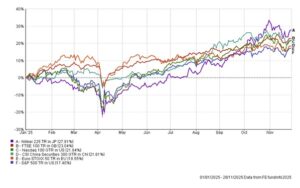
Investors also remain confident that the Federal Reserve will continue to cut interest rates, as the US labour market cools. Federal Reserve chair Jerome Powell, who has successfully steered the US economy through choppy waters, steps down from his role in May 2026, with his replacement likely to be sympathetic to President Trump’s desire to see significantly lower interest rates. Such a move is risky and may cause inflationary pressure to build once again.

Away from the US, Japan’s Nikkei 225 index broke through the 50,000 barrier for the first time, and Chinese markets also outperformed. European stocks also ended the year higher, with strong global demand feeding into the performance of the FTSE100.

Greater polarisation

2025 has been a year where global markets have become even more polarised, given the rapid increase in market capitalisation of global tech giants. The combined market capitalisation of Nvidia, Apple and Microsoft now stands at over $12 trillion, over four times larger than the combined value of all one hundred constituents of the FTSE100. The size and market weight held by a handful of companies simply increases the risk of a pronounced reversal in global indices should one or more of the biggest US stocks fail to meet sky high earnings expectations.

The last 12 months has seen a clear division between those sectors that have outperformed and those that have lagged. Apart from Technology, Industrials – particularly those involved in the manufacture of defence equipment – have seen surging order books on the back of increased defence spending commitments and infrastructure projects. Banks have also been well-supported, and increases in commodity prices have boosted the Mining sector.

Consumer-related stocks have been overlooked over the course of 2025. The US is experiencing “K” shaped economic growth, with the gap between the financial prospects for higher earners, and those on middle and lower incomes, widening. This disparity has not been helped by the longest-ever US government shutdown that started in October and lasted 43 days. Property related stocks have also struggled to gain traction, and pharmaceuticals have continued their underperformance, as regulatory headwinds remain. As always, sector underperformance can present opportunities where stocks carry lower ratings.

Geopolitical influence

Although it may have been a quieter year for politics than 2024, when major elections were held in the US, UK and elsewhere, markets have continued to grapple with political influence in the form of decisions taken by the US administration. The imposition of tariffs was the primary cause of market uncertainty earlier in the year, and we expect tariffs to return to the headlines in coming months, as the US has yet to finalise deals with its’ major trading partners. Furthermore, the US Supreme Court will shortly rule on the legality of the broad tariff programme, which could derail plans by the White House.

Tensions in the Middle East may have subsided at present; however, significant distance remains between Ukraine and Russia in their attempts to reach a peace deal. Markets remain susceptible to any heightening of tensions in the region, which could damage investor confidence.

Not just equities

Equity markets have not been alone in enjoying a positive 2025; investors in fixed income have seen a year where returns have been consistent, amidst a backdrop of global monetary easing. Government debt to Gross Domestic Product (GDP) ratios continue to expand; however, corporate balance sheets look comparatively healthy, with default rates amongst investment grade debt standing at historically low levels. For those holding diversified portfolios, the smooth performance curve of fixed income over the course of the year has served to reduce equity volatility, which was more apparent in the first half of 2025.

Seasons Greetings

As 2025 draws to a close, we look forward to a year that may present investors with greater challenges but remains full of opportunity. Our first Wealth Matters of 2026 will set out our thoughts on the key themes for the coming year. We take this opportunity of wishing our readers a Happy Christmas and a healthy and prosperous 2026.


Protecting family wealth from Inheritance Tax

By | Financial Planning

The Budget delivered on 26th November contained no significant changes to Inheritance Tax (IHT). Following the reforms announced in the 2024 Budget to Business and Agricultural relief, together with the upcoming changes to the way unused pensions are treated, the lack of fresh announcements was not unexpected; however, the continued freeze on Inheritance Tax bands until 2031 announced as part of this year’s Budget is a stealth tax increase, that will drag more estates into the scope of IHT and increase the burden on estates already impacted.

The nil rate band for Inheritance Tax – i.e. the amount an individual can give away before IHT applies – has remained static at £325,000 since 2009, and the recent measures announced effectively mean this band will not have increased for 22 years. Granted, the Main Residence Band, which covers the family home when left to direct lineal descendants, and the transfer of bands between spouses, give additional headroom before death duty becomes payable. Despite this, increases in the value of investments and residential property over the last two decades mean that even modest estates are now at risk of an IHT charge.

Given these factors, it is no surprise to us that Inheritance Tax planning is becoming a key financial consideration for families. Protecting family wealth and ensuring this can be passed on to the next generation without onerous tax liabilities, is a common topic of conversation with clients, and one that will become a more pressing issue for many once the changes to the treatment of unused pensions come into force in 2027.

Introducing Discretionary Trusts

In a recent edition of Wealth Matters, we started to consider how Trust planning can be used to mitigate a potential IHT liability and focused on Loan Trusts as being a way to protect future growth on the value of assets from IHT, whilst the settlor (the person making the loan) retained the ability to receive repayment of the loan, if they required funds. This only provides partial protection from IHT, as the outstanding loan remains in the individual’s taxable estate.

A more effective, but less flexible, form of IHT mitigation is to make a gift into a Discretionary Trust. To be effective for IHT purposes, the settlor needs to be excluded as a beneficiary. Without this exclusion, the settlor would retain a “reservation of benefit,” rendering the gift ineffective for IHT planning. An often-cited example of this is an individual gifting the family home into Trust but remaining resident in the property without paying a market rent. This would be considered such a reservation of benefit.

Gifts into Trust reduce an individual’s nil rate band by the amount of the gift, although gifts into Trust over £325,000 are liable to an upfront charge to IHT of 20% on the excess above the nil rate band. Assuming the donor lives for seven years, the gift is then considered outside of the donor’s estate.

The Discretionary Trust Deed will set out who can benefit from the Trust; however, the Trustees will have discretion over who receives benefits from the Trust and in what proportions. No single beneficiary has any direct entitlement to the Trust assets, and instead, the Trust Deed names a pool of potential beneficiaries. In most cases, this will be the direct family of the settlor (children, grandchildren, and great grandchildren) and can include direct lineal descendants not yet born. The settlor will usually appoint themselves as one of the Trustees, along with their spouse, and adult children.

This creates a “family trust” that can benefit any family members in the future. When we discuss establishing such lifetime Trusts with clients, the settlor often considers situations such as helping grandchildren through university, advancing funds at key birthdays, or providing funds for future generations to help them place a deposit on their first home, as being an appropriate time to consider advancing funds from a Discretionary Trust.

Keeping funds within a Trust arrangement can also help protect family wealth in the event of matrimonial breakdown within the family, or where funds that would otherwise be gifted directly to family members, may be spent unwisely.

Tax and Trust investments

When investing Trust assets, the Trustees need to adhere to the requirements of the Trustee Act, and ensure that Trust funds are prudently invested, provide adequate diversification and are reviewed to consider whether they remain appropriate.

Discretionary Trusts are subject to a punitive tax regime, which makes the choice of investment vehicle even more important. Trustees pay tax at a rate of 39.35% on dividend income and 45% on interest, and they also only receive 50% of the Capital Gains Tax allowance enjoyed by an individual. As a result, an Onshore Investment Bond is often selected as an investment vehicle, as it is taxed internally at a lower rate, and segments of the Bond can be assigned to beneficiaries when the Trustees agree to advance funds. The act of assignment does not trigger a tax charge, leaving the beneficiary to surrender the segments advanced at their own marginal rate of tax, which is often lower than the rate applicable to Trusts.

How we can help

Establishing a Discretionary Trust during an individual’s lifetime can be an effective tool to reduce a potential Inheritance Tax liability and protect family wealth. Decisions around the creation of the Trust, the selection of an appropriate investment strategy and ongoing management of the Trust assets are areas where our experienced team can provide advice.

It is, however, important to recognise that Trust planning is just one tool available to mitigate a potential Inheritance Tax liability. Other options, such as Business Relief investments, regular gifting strategies or protection policies, may be more appropriate, depending on your circumstances. Our independent advisers can take a holistic view of your potential estate and consider solutions from the whole of the market and provide advice on the option or options that best suit your needs. Speak to one of our team to start a conversation.

Will 2026 be the year when active management is back in fashion?

By | Financial Planning

We have previously commented on the growing popularity of passive investment across the industry, and the dangers of relying on a passive only approach when constructing an investment portfolio. This year has, to date, seen major global indices advance, leading to reasonable outcomes for those investing in tracker funds. With global equity indices becoming more concentrated, and the S&P500 and Nasdaq looking fully valued, 2026 could well be the year when active fund management can provide superior performance.

Over the last decade, passive investment funds have grown in popularity, receiving significantly higher inflows than active funds over the last five years. Some in the industry, and many financial “influencers” (whose “advice” we recommend you treat with caution) focus on an evidence-based investment approach, which argues that it is difficult for active managers to beat the market over time, and any strategy should, therefore, be exclusively held in passive investments.

The rise in the popularity of passive strategies is also evident from our own market analysis. Our Investment Committee regularly undertakes a comprehensive review of managed portfolio solutions offered by discretionary fund managers, and our analysis clearly demonstrates that many of our competitor’s products and services carry an increasing bias towards passive investments.

Why passive investments are not the panacea

It is unarguable that passive funds provide a low-cost way of accessing global markets, and they have a place in most diversified strategies; however, we contend that passive funds should be used as part of a broader strategy which includes actively managed funds. Supporters of passive investments fail to take account that a passive investment fund will only track – and never beat – the representative index or market it is trying to replicate. Furthermore, due to tracking errors, most passives lag their target index by a small margin.

Adopting a pure passive approach also means that when the index falls, so does the value of the tracker fund. Unlike a fund with an active manager, who could potentially take avoiding action by reducing allocations, increasing the percentage of cash, or using derivatives, the passive fund will simply follow the representative index.

Over recent years, active fund managers have found it difficult to consistently outperform major global indices, in particular US large cap indices such as the S&P500. Those who champion a passive only approach use such evidence as rationale for their exclusive use of tracker funds. Whilst this has historically been the case, we have noted more actively managed funds investing in the world’s largest market are now producing outperformance over the medium term. This trend may well continue if indices fail to make significant headway during 2026.

A well-documented area in which passive investment has limitations are Fixed Income funds which invest in Government and Corporate Bonds. While passive strategies are often primarily associated with Equities, the universe of passive bond funds has expanded significantly over recent years, encompassing UK and Global benchmarks and providing exposure to portfolios comprising hundreds to thousands of individual bond positions.

Whilst these funds provide broad market exposure, our experience shows that active Strategic Bond managers, who can adjust duration exposure, and portfolio credit quality, can respond to macroeconomic conditions, monetary policy shifts, and evolving credit fundamentals, to adjust their portfolios to take best advantage of the prevailing and expected conditions.

Why 2026 may be tougher for passives

Whilst global market indices have advanced over 2025 to date, the headline index performance masks a significant variance in performance across different sectors. For example, at the time of writing, the largest seven components of the S&P500 index – Nvidia, Apple, Microsoft, Amazon, Alphabet, Broadcom, and Meta – account for 35% of the index by weight. Whilst robust performance from Tech stocks over the second half of 2025 has helped propel index performance, the valuations of leading names have become stretched in places, and any weakness in the sector will have a disproportionate impact on the performance of the index. Amongst the remainder of the S&P500, there are undoubtedly pockets of value, which can be exploited by an active manager, who can allocate a greater proportion of the portfolio to undervalued positions. By doing so, they may also be able to limit the risk to the downside if market sentiment turns.

Our approach

We always aim to seek out good value for our clients, and our independent status allows us to take an unbiased approach as to the precise blend of funds we select. The FAS Investment Committee undertake considerable research on a sector and region basis when we conduct the regular review of funds that we recommend to clients, which encompasses both active and passive options. As a result, this allows us to select passive funds, where this is appropriate, but blend in active funds where we see outperformance.

Our preference when selecting active funds is to choose managers who adopt a conviction-based approach and have a clear vision as to how their fund is to be positioned. This can often mean investing in a concentrated portfolio, when compared to the representative region or universe of stocks available. We regularly come across actively managed funds that align their portfolio closely to the benchmark index. In most instances, such funds fail to impress, as they levy higher charges for active management, without providing the prospects for outperformance.

Summary

We believe passive investment funds have a place in any sensible portfolio, as they provide a low-cost way of accessing broad market exposure; however, we do not subscribe to the mantra of many in the industry who believe it is the right approach in all circumstances. We continue to recommend clients also gain exposure to good performing actively managed funds which can provide significant outperformance and drive overall portfolio returns.

Whilst passive funds provide a low-cost option, we have secured discounts on a range of good-performing actively managed funds over recent years, where charges are only slightly higher than the passive alternative. We will, of course, continue to negotiate lower fund charges with leading fund houses where possible.

If your investment manager is using a passive only approach, we feel it may be a good time to consider whether this remains appropriate. Speak to one of our experienced advisers to discuss your portfolio asset allocation.