

The popularity of ethical investment strategies has seen significant growth over recent years, as more investors aim to align investments with their own values. During 2025, however, socially responsible funds suffered significant outflows as investors grew increasingly concerned about performance. Defence and weaponry and fossil fuel energy were amongst the best performing sectors over the last year, neither of which would generally feature in a socially responsible investment strategy. As a result, ethical strategies have struggled to match the performance achieved through a mainstream investment approach.
Whilst performance considerations are clearly important, the availability of investment solutions that meet the necessary criteria is another key factor. Tighter regulation of sustainable investments has been seen across regulatory frameworks, including the introduction of the Sustainability Disclosure Requirements (SDR) that have encouraged fund managers to apply for a sustainable label, which helps to demonstrate the fund’s commitment to socially responsible investment. As a result, several leading fund managers have changed their fund mandates to remove ethical screens.
At FAS, we have always taken a common-sense approach to sustainable investment. We appreciate that investors may wish to hold a portfolio that aims to make a positive impact on the World in which we live, and for those with strong ethical considerations, we can build a bespoke advisory portfolio which meets strict criteria.
The CDI Future portfolios
We also provide discretionary managed options for clients wishing to invest in a socially responsible manner. When designing the socially responsible CDI discretionary managed portfolios, the FAS Investment Committee considered feedback from many clients, who expressed the desire to invest with a conscience, without wishing the ethical criteria to be too restrictive that it narrowed the available universe of investment options significantly.
The CDI Future Balanced and CDI Future Progressive portfolios are both designed to provide growth over the longer term, by investing in Collective Investments holding a blend of UK Equities, Global Equities, Corporate Bonds and Infrastructure investments. Future Balanced has a maximum equity allocation of 65% and caters for clients wishing to accept medium levels of investment risk. Future Progressive holds up to 85% in equities.
In both cases, the Investment Committee aim to invest at least 70% of each portfolio in funds that either actively screen their portfolio to avoid common areas of concern (such as fossil fuels, tobacco, gambling and weaponry amongst others) or track an index where the composition of the index is screened to remove stocks that fail to meet the necessary ethical criteria. We feel this allocation reaches a sensible compromise, ensuring that more than two-thirds of the portfolio meets rigid criteria, whilst allowing a smaller proportion of the portfolio to be invested in sectors and regions of the World where ethical investments options are less common, such as the US or Asia.
The portfolios are constructed in the same manner as the other CDI portfolios, by selecting funds from across the whole of the market. Funds that pass the quantitative filtering process are then subject to additional screening. For actively managed funds, careful consideration is given to the socially responsible investment approach adopted and how the fund manager applies the various restrictions. In the case of passive funds, additional due diligence is undertaken to consider the screening process adopted by the index creator.
The performance cost of sustainable investing
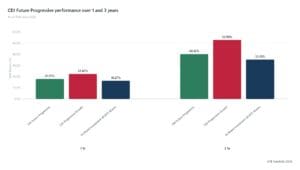
The CDI Future portfolios have both consistently outperformed the respective benchmark for each portfolio over both 1 and 3 years. The Investment Association benchmarks are themselves not subject to the restrictions of ethical screening, and therefore the comparative performance achieved by the two Future portfolios is impressive.
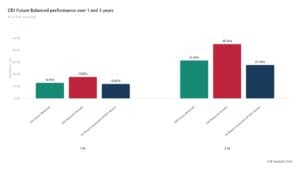
Performance against the benchmark does, however, only tell half of the story. The two charts above and below also plot the performance of CDI Balanced Growth and CDI Progressive Growth, which carry the same level of risk as CDI Future Balanced and CDI Future Progressive respectively, and are constructed using the same investment process – but without the socially responsible screen. As demonstrated by the relative performance, investing in a socially responsible manner has historically led to a performance penalty against the returns an investor not taking ethical considerations into account has achieved.
What lies ahead for ethical investment
We live through uncertain times, with conflict in Europe and the Middle East likely to lead to continued investor demand for stocks that do well as a result of the ongoing geopolitical turbulence. In the short term, it is difficult to see the performance gap between ethical and mainstream investment strategies narrowing significantly.
The CDI Future portfolios have, however, demonstrated consistent outperformance of the wider sector benchmarks, and provide a robust solution for investors who wish to limit their exposure to companies whose products and services have a negative social or environmental impact. The FAS Investment Committee also regularly analyse the performance of the CDI Future portfolios against sustainable and responsible investment mandates offered by leading portfolio managers, to ensure the performance of our discretionary managed services remains consistently strong against real-world competitors.
If you wish to invest in a socially responsible way or wish to discuss the potential implications of adopting a sustainable investment approach, then speak to one of our experienced advisers. We can offer both discretionary managed and advisory investment approaches that aim to meet concerns over portfolio sustainability and would be pleased to provide an unbiased review of an existing portfolio.